
Klimaänderung und Gletscher
Das Eis der Gletscher ist ein Klimaarchiv, und Gletscher sind das oft zitierte Gedächtnis der Klimageschichte: Der spektakuläre, weltweite Rückzug der Gebirgsgletscher gehört zu den sichtbarsten Zeichen, dass sich das Klima der Erde seit dem Ende der Kleinen Eiszeit um die Mitte des 19.Jahrhunderts – mit Beginn der Industrialiserung – markant verändert hat.
Gebirgsgletscher gelten als Schlüsselindikatoren für Klimaänderungen, sozusagen als eine Art globales Fieberthermometer.
Die Vereinten Nationen haben 2025 zum Internationalen Jahr der Erhaltung der Gletscher erklärt, um die entscheidende Rolle der Gletscher für unser globales Klima zu unterstreichen. Dazu wurde der 21. März als Welttag der Gletscher ausgerufen – ein wichtiges Zeichen für den Schutz dieser einzigartigen Eis-Landschaften.
Alpengletscher
In den Alpen ist der Gletscherschwund besonders gut untersucht: Seit Mitte des 19. Jahrhunderts – mit Beginn der Industrialisierung – bis Mitte der 1970er Jahre verloren die Alpengletscher im Durchschnitt etwa ein Drittel ihrer Fläche und die Hälfte ihres Volumens.
Im extrem heißen Sommer 2003 gingen nach Schätzungen allein 5 bis 10% ihres Gesamtvolumens vom Jahr 2000 verloren.2
Und so ging der Schmelzprozess weiter:
In den beiden Jahren 2022 und 2023 haben die Gletscher insgesamt 10 % ihrer noch vorhandenen Eis-Masse verloren.
Das Jahr 2024 war weltweit das heißeste Jahr sein Beginn der Messungen. Weitere Faktoren trugen trotz des Schneefalls im Winter zu einem zusätzlich starken Schmelzen der Alpen-Gletscher im Sommer bei:
- Sehr hohe Temperaturen im Juli und im August 2024, besonders auch in höheren Lagen. Unterhalb von 3000 m gab es keinen Neuschnee.
- Häufig trockene Bedingungen und hohe Sonneneinstrahlung.
- Und Saharastaub, der sich im Winter 2023/2024 sowie im Frühjahr 2024 auf Schnee und Eis ablagerte. Damit wird die Rückstrahlung – „Albedo“- von Schnee und Gletschereis verringert und die Schnee- und Eisschmelze markant verstärkt.
- Gletscherforscher rechnen mit dem fast vollständigen Abschmelzen der Alpengletscher noch in diesem Jahrhundert (Schweizer Gletschermessnetz GLAMOS).
Der Schwund der Gebirgsgletscher ist ein globales Phänomen.
Ein internationales Forschungsteam mit Beteiligung der ETH Zürich zeigt auf: Fast alle Gletscher weltweit werden immer dünner und verlieren an Masse – und das immer schneller.
CO2 und der Treibhaus-Effekt
Der Hauptgrund für die Erderwärmung ist der Ausstoß ungeheurer Mengen von Treibhausgasen wie Kohlendioxid (CO2) vor allem durch die Verbrennung fossiler Brennstoffe in den Industrie- und Schwellenländern.
Der weltweite Ausstoß von Kohlenstoffdioxid nahm seit 1960 kontinuierlich zu und erreichte im Jahr 2023 einen Wert von knapp 37,8 Milliarden Tonnen Kohlenstoffdioxid.
Dieser hohe CO2-Ausstoß hatte einen weiteren Anstieg der CO2-Konzentration in der Erdatmosphäre zur Folge: Der Wert von 426 ppm (parts per million) wurde Anfang Februar 2025 erreicht Der Konzentrationsverlauf des Spurengases Kohlendioxid wird seit 1960 in einer Kurve – der Keeling-Kurve – aktuell grafisch dargestellt (https://keelingcurve.ucsd.edu/).
Während mindestens 800’000 Jahren bewegte sich die CO2-Konzentration in der Atmosphäre in einer Bandbreite von 180 bis 300 ppmv (ppmv = Anzahl Moleküle pro Million in einem bestimmten Volumen)7.
Die CO2-Emissionen der Menschheit haben seit etwa 1850 – mit Beginn der Industrialisierung – zu einem massiven Anstieg dieser Konzentration geführt. Nach allem, was wir wissen, war der CO2-Wert in der Menschheitsgeschichte – seit es den Homo sapiens gibt – noch nie so hoch.
In den nächsten Jahren wird sich dieser Prozess noch beschleunigen. Die Klimawirksamkeit von CO2 und anderer Treibhausgase setzt erst mit zeitlicher Verzögerung von drei Jahrzehnten ein. Heute sind wir vom CO2-Ausstoß von vor 30 Jahren betroffen. Gleichzeitig verursachen wir täglich die Klimaänderung der nächsten 30 Jahre.
Der Klimawandel wirkt nicht „nur“ durch den Anstieg der Temperatur. Auch Stärke und Häufigkeit der Wetterextreme haben bereits außergewöhnlich zugenommen. Mit der Erwärmung steigt die Verdunstung über den Ozeanen. Der Meeresspiegel steigt und stärkere Tiefdruckgebiete bilden sich aus. Die Energie entlädt sich in heftigen Stürmen, Orkanen und sintflutartigen Niederschlägen. Auch längere Hitze- und Dürreperioden gehören zum Wettergeschehen im Klimawandel. Die Auswirkungen sind drastisch: Überflutete Landschaften und Schneemangel oder auch meterhohe Schneefälle und im schnellen Wechsel auch hohe Temperaturen in den Alpen.
Die Wetterextreme werden mit der Ausbildung „stationärer Jetstreams“ in Verbindung gebracht. „Jetstream“ werden die Luftströmungen in großer Höhe genannt, die in der nördlichen Hemisphäre in west-östlicher Richtung strömen und in weiten Wellen nach Süden und Norden ausgreifen. Sie bestimmen die Tief- und Hochdruckgebiete. Auch diese Entwicklung gehört zum Klimawandel.
Unter bestimmten Bedingungen wandern diese Wellen ungewöhnlich langsam, verstärken sich und führen dann zu extremen Wetterlagen in den unteren Schichten der Atmosphäre.
… in den Alpen
Im Alpenraum fällt die Erwärmung bis zu dreimal höher aus als im weltweiten Durchschnitt. Die Temperatur nimmt dabei in der Höhe schneller zu als in tieferen Lagen. Im Sommer zeigen sich die Folgen am schnellen Abschmelzen der Gletscher und an der Zunahme von Muren und Bergstürzen.
Alle Klimafaktoren können sich in ihrer regionalen Verteilung unterschiedlich entwickeln: Intensität und zeitliche Verteilungsmuster der Strahlung, Verringerung der Albedo, Verdunstung von Wasser, Luftfeuchtigkeit, zeitliche Verteilung und Intensität von Niederschlägen und Schneemengen, Temperatur, Luftdruck und Luftbewegung.
„In der Schweiz ist die bodennahe Nullgradgrenze seit dem Beginn der Wetteraufzeichnungen vor über 150 Jahren um 200 bis 700 Meter angestiegen, besonders stark im Winter. Seit den 1970er Jahren hat sich der Anstieg beschleunigt, vor allem im Frühling und im Sommer. Der Hauptgrund für diese Entwicklung ist die menschengemachte Klimaerwärmung.“
Warum die Alpengletscher schmelzen
Nicht nur Schneemangel im Winter, sondern vor allem die strahlungsintensiven und warmen Frühlings- und Sommermonate und die Starkregenfälle sind für das schwindende Volumen und die negative Massenbilanz der Gletscher entscheidend.
Der Gletscherschwund wird über den Klima-Effekt hinaus auch durch die Luftverschmutzung (und den direkten Schmutzeintrag in Gletscherskigebieten) verstärkt, vor allem durch Feinstaub und Ruß, Eine weiße Eisoberfläche reflektiert das Sonnenlicht fast vollständig. Diese sogenannte Albedo nimmt ab, je dunkler die Gletscheroberfläche durch Schmutzpartikel wird: Das Eis nimmt mehr Sonnenwärme auf.
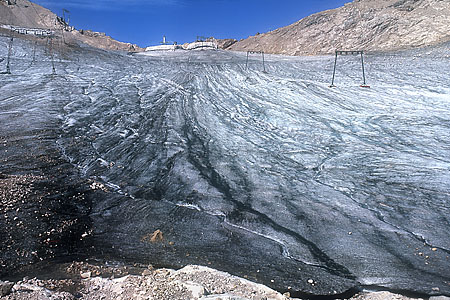
Gletscherdreck: Schneeferner Zugspitze, Bayern, 2003 © GöF
Auch andere Rahmenbedingungen ändern sich. Durch die Schwächung der Ozonschicht nimmt die kurzwellige energiereiche UV-Strahlung zu.
Dazu kommen die durch Abgase, fossile und andere Verbrennungsprozesse veränderten luftchemischen Reaktionen und Niederschläge (Saurer Regen). Gletscher sind nicht nur ein Klimaarchiv. Sie speichern auch die industrielle Verschmutzung. Mit dem Abschmelzen gelangen diese Gifte wieder zum Vorschein.